
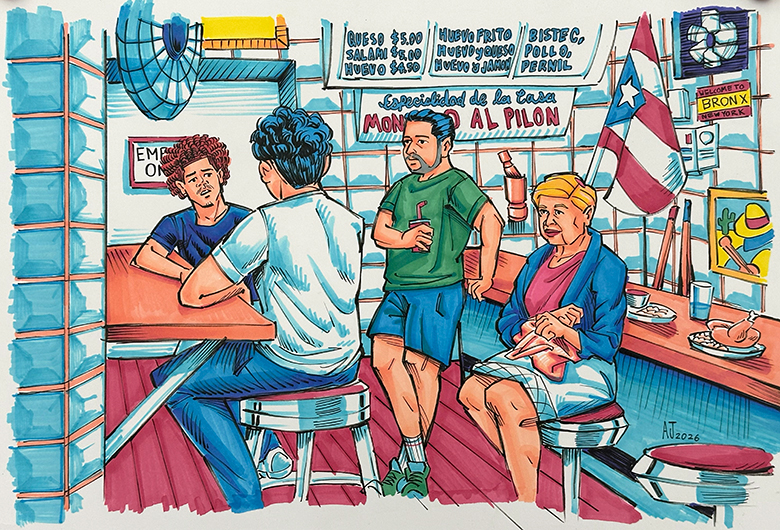
Dr. Richard A. Vladovic Harbor Teacher Preparation Academy, Wilmington, California, USA
Dr. Richard A. Vladovic Harbor Teacher Preparation Academy, Wilmington, California, USA
Candice Gutierrez
Candice Gutierrez
AP 2-D ART AND DESIGN
NAME OF THE ARTWORK
Height: 24" | Width: 19"
Idea(s): Explored a faded memory of my absence, sparking curiosity of unlocking parents forgotten love.
Material(s): Acrylic paint, oil paint, cardboard, metallic gold pen, prisma colored pencils
Process(es): Acrylic underpainting, portrait w/ colored pencil, paint background w/oil, layered cardboard frame
Citation(s): Personal photos
Curatorial Note: This drawing captures the emotional experience of a teenager caught in the middle of a family separation, conveying its complexity, uncertainty, and confusion.
How can I illustrate my experiences with overcoming parental conflict?”
Student Statement
Student Statement
What was one important change you made while developing this artwork, and how did it strengthen the result?
One important change I made was changing the form of the picture frame to emphasize the complex story of exploring parental separation in adolescence. I originally wanted to paint the picture frame, but I realized it looked too flat and lacked depth. So I experimented with cardboard and plaster to add a 3-D element to make myself pop out of the picture and unlock the memory. However, it still gave the same results as the original idea so I decided to add pieces of cardboard scattered around the background to reflect overwhelming emotions. This strengthened the relationship between my curiosity and the hidden truths of my parents' marriage.
What did you do before beginning this artwork? Describe any planning, research, source image, sketches, studies, or other preparation you used.
I noticed successful AP artworks gained inspiration from other artists to learn from their techniques and ideas and applied into their own artworks. So, I reviewed the online Getty Museum Gallery and referenced Tim Walker's photograph before beginning any sketches. This led me to taking hundreds of reference photos in my bathroom, mimicking the figure reaching out from the frame similar to Walker's photo. Then I drafted concept sketches using procreate, testing different ways to alter my parents photo to show a lost memory. After choosing the composition I wanted, I practiced sketching and layering diluted acrylic paint with prisma colors.
Describe one material, technique, or approach you deliberately tested. What did the test help you decide?
I was inspired by a technique used by a YouTube artist that worked really well to draw realistic portraits. Using this same approach, I created a graphite sketch, applied an acrylic wash to block out main colors, and used colored pencils to refine details and textures. I practiced this technique repeatedly in my sketchbook to test which dilution of paint will best work for blending color pencils. I discovered that semi-diluted acrylic worked the best and created a smooth blend I wanted for the skin. The color pencil didn’t leave any harsh streaks that I tested with full dilution on acrylic paint and wasn’t translucent like the pure acrylic wash. This process helped me improve my realism technique and become more comfortable with using mixed media.
What did you practice more than once while making this artwork? What improved or became clearer through that practice?
I practiced drawing the hand the most because I have never drawn hands before. I wanted to perfect it and make sure I was adding shadow in the correct areas and layering colors to create a specific skin tone that a single-color pencil couldn’t achieve on its own. By practicing, I learned that blending was not my main objective but translating the correct tones from the image to paper was important in making the hand look more realistic. I began blocking out colors, focusing on the entirety of the drawing rather on smaller details. It helped me color more realistic features on the hand that I eventually translated to my final artwork.
What specific choice or revision resulted from critique or feedback?
My teacher noted that my initial artwork was very flat and needed a 3-D element to create depth. As a result, I began experimenting with three-dimensional materials, using cardboard and even trying plaster for the first time to create texture. Though adding the frame did create more dimension, I still wasn’t satisfied with the empty space. So, I tried cutting out smaller pieces of cardboard throughout the background to create more movement. This revision helped strengthen the visual impact of my piece, while also challenging me to experiment with new materials.
Your turning point: What is one experiment, unexpected result, piece of feedback, or discovery that changed the way you made your art?
Through art, I'm trying to discover a part of me that I keep hidden from the world. It has helped me embrace these experiences good or bad because they have all shaped me into the person I am proud to be today.
Teacher Statement
Sophia Rowen
Head of Visual Arts
How did your student grow as an artist during AP Art and Design? Please share a specific example of their growth.
Over two years of sequential art instruction—beginning in Drawing and Painting and culminating in AP Art and Design—Candice evolved from a technically proficient renderer into an inquiry-driven visual communicator. In her foundational year, she demonstrated strong 2-D rendering skills, executing realistic portraits in acrylic, gouache, and oil paint, as well as 3-D form through wearable paper-mache masks created for our school’s cultural fair. As her technical confidence expanded, she began applying spatial design principles outside the art classroom by constructing sets for our school’s theater productions. In AP Art and Design, her growth accelerated as she transitioned from foundational technical skill to mastering the AP Course Framework’s core pillars: Inquiry and Investigation, Practice, Experimentation, and Revision, and the Synthesis of Materials, Processes, and Ideas.
How did you help students move from an initial topic, interest, or question toward an inquiry that could guide exploration and discovery over time?
I encouraged Candice to shift her focus from observational representation to guiding her practice through deep personal inquiry. Through one-on-one check-ins, mind-mapping, and sketchbook work, I helped leverage her sustained investigation to explore vulnerable personal themes surrounding family dynamics, a broken home, and emotional instability. Rather than relying solely on direct depiction, she developed a sophisticated visual vocabulary anchored in recurring symbolic motifs: Divers: Symbolizing the act of plunging into deep emotional depths and navigating unarticulated family tensions. Closed Doors and Portals: Representing physical and psychological boundaries, emotional isolation, and threshold transitions within a domestic space. Still-Life Painting: Harnessing her technical mastery of light, surface, and composition to ground abstract emotional narrative in tangible everyday objects.
How did you structure opportunities for practice, experimentation, and revision to help students develop their sustained investigations?
I introduced new processes and materials like the Xtool laser cutter machine for students to use as a mini sustained investigation starting point. This allowed students to explore a new digital fabrication tool, bridging their 2-D conceptual sketching with 3-D structural design. Candice was investigating childhood memory within her sustained investigation, so she set out to construct a replica of a toy car from her past. Practice & Revision: She began by producing detailed concept sketches, testing scale, proportion, and structural breakdown on paper. Material & Process Experimentation: Stepping outside her comfort zone of traditional paint and paper-mache, she taught herself to operate the studio’s laser cutter machine, translating her hand drawings into vector cut paths and assembled components. Synthesis: The finished piece demonstrated advanced synthesis—using precision laser cutting and assembly processes to physicalize a preserved memory object that directly informed her inquiry into childhood and home life.
How did you help students develop and apply 2-D, 3-D, or Drawing skills to make more intentional choices in their artwork?
I guided students to develop and apply 2-D, 3-D, and Drawing skills intentionally through a structured, inquiry-based framework: Focused technical foundation: Students built technical proficiency through targeted exercises in mark-making, line quality, spatial organization, and media experimentation within their sketchbooks before tackling final pieces. Iterative planning & media testing: Prior to project execution, students generated preliminary compositional sketches, tested non-traditional tools, and created structural iterations to explicitly connect their chosen materials and processes with their underlying ideas. Structured critique & reflection: Students participated in group/peer critiques and wrote ongoing reflections analyzing visual intent, helping them critically evaluate compositional choices and refine their artwork with clear artistic purpose.
How did you integrate writing into students’ artmaking and thinking to help them clarify and communicate their ideas?
I integrated writing into students' art making and thinking through a structured framework of inquiry formulas and reflective prompts: Inquiry Question Proposals: Students used guided formulas and brainstorming to draft open-ended inquiry questions that explicitly linked their choice of materials, processes, and underlying ideas. Studio Progress Logs & Reflective Writing: Students completed weekly progress logs and self-reflections using targeted action verbs and sentence prompts (e.g., "I used [technique] to show [concept]") to explain the rationale behind their visual and technical choices.
How did you use critique, feedback, and peer interaction to help students strengthen their thinking and artmaking?
I integrated structured critique, rubric-aligned assessment, and continuous dialogue into the studio routine to deepen students' conceptual thinking and refine their art making: Weekly n-progress critiques: Students displayed ongoing work weekly, normalizing reflection and iterative growth early in the creative process. Rubric-guided assessment: Students used the AP Art and Design Sustained Investigation rubric for self and peer evaluations, developing a clear understanding of criteria like inquiry, experimentation, revision, and synthesis. Structured peer interaction: I organized small table groups and peer pairs to give targeted, constructive feedback. Inquiry-driven 1-on-1 meetings: During individual check-ins, I consistently asked students how their technical and visual choices directly linked back to their central inquiry question.
How did you help students evaluate, select, and present their strongest artworks for Selected Works?
I guided students through a structured review process to curate and present their top 5 pieces for the Selected Works section: Exemplar benchmarking: Students analyze official portfolio examples on the AP Art and Design website to establish a clear standard for high-level execution and the synthesis of materials, processes, and ideas. Curatorial selection: As students complete their Sustained Investigation, we evaluate their full body of work together to select up to 5 pieces that showcase their highest technical skill and conceptual rigor. Targeted creation window: With 1–2 months remaining before the submission deadline, we audit the chosen set; if a piece lacks strength or visual coherence, students have structured time to produce a replacement piece without rushing. Written evidence: I assist students in documenting their selected works according to College Board criteria, ensuring accurate measurements and concise written commentary detailing their materials, processes, and ideas.
What strategies did you use to secure and manage the materials and resources needed to support your AP Art and Design students?
For example, you may describe budgeting, advocating for resources, grants, fundraising, donations, partnerships, purchasing decisions, or creative approaches to using available materials.
To keep my AP Art students supported, I lean heavily on a mix of hands-on training, scoring experience, and teacher networks. Attending the SCAD Summer Institutes and district workshops gives me fresh studio techniques and great supply recommendations. Working as an AP Reader helps me focus our budget on the exact tools that drive portfolio success. Plus, staying active in educator Facebook groups and the AP College Board community lets me crowdsource ideas, budget hacks, and digital tools from other teachers.
What advice would you offer other AP Art and Design teachers based on your experience teaching the course?
Focus on the process early, not just polished final pieces. Helping students refine a strong inquiry question and document their experimentation from day one makes building the Sustained Investigation far less overwhelming.
Principal Statement
Principal Statement
Jane Doe
Principal
Lorem ipsum dolor sit amet, consectetur adipiscing elit. Curabitur vel nulla mi.
Read the Statement
KEEP EXPLORING